
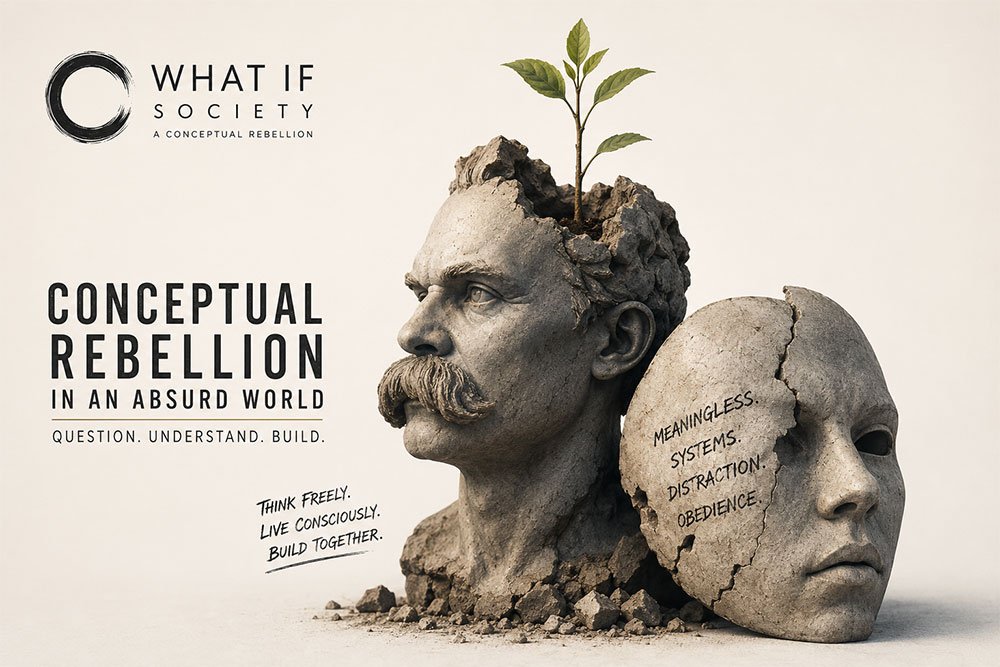
We are living through a strange moment in history. The institutions that once promised stability, now feel hollow. The systems that claim to serve us feel distant. The narratives that once gave our lives direction, are no longer convincing. And yet, we’re expected to act as if everything is normal.
More than a century ago, philosophers like Friedrich Nietzsche and Albert Camus anticipated exactly this kind of crisis. They weren’t writing about algorithms, global debt, or digital surveillance, but they were writing about something deeper: what happens when the structures that give life meaning begin to collapse.
Nietzsche warned that as traditional beliefs lose their authority, humanity risks drifting into nihilism — a sense that nothing matters. His solution was radical: individuals must create their own values rather than inherit them blindly. If we don’t consciously choose what matters, we will unconsciously absorb whatever the surrounding system promotes. In today’s world, that often means status, consumption, outrage, or endless distraction.
Camus took a different approach. He argued that life is inherently “absurd” — not because it is meaningless, but because humans crave meaning in a universe that offers no clear answers. For Camus, the correct response was neither despair nor blind faith, but rebellion: a clear-eyed refusal to pretend things are fine while still choosing to live with dignity. Not violent rebellion. Not utopian fantasy. Simply the courage to see reality as it is and act humanely anyway.
This is where ideas like Conceptual Rebellion and the What If Society enter the conversation.
They do not ask us to destroy everything. They do not promise a perfect future. Instead, they begin with a simple premise: many of the systems shaping our lives no longer serve human flourishing, yet they persist because they are familiar, profitable, or difficult to challenge. Questioning them is not extremism — it is responsibility.
Unlike Nietzsche, which emphasizes exceptional individuals, or Camus, which centers on personal revolt, Conceptual Rebellion adds a 21st-century insight: our problems are now structural and collective. It is no longer enough for isolated individuals to “create meaning” on their own while living inside systems that undermine dignity at scale.
That is why the idea of a Magna Carta for the 21st Century matters. The original Magna Carta did not create utopia; it simply placed limits on unchecked power. Today, power often resides not in kings but in opaque financial systems, global corporations, and algorithms that shape perception itself. A modern charter would not dictate beliefs — it would establish boundaries, transparency, and accountability so human freedom can exist in practice, not just theory.
The unifying thread across Nietzsche, Camus, and this emerging framework is the rejection of passive acceptance. None of them argue that we should wait for saviors, trust blindly in authority, or assume progress is automatic. Meaning, dignity, and freedom require participation.
But there is also an important warning embedded in their work. Rebellion can become dogma. Movements can become the very structures they oppose. Camus especially cautioned against revolutions that justify cruelty in the name of justice. Any effort to reshape society must remain grounded in humility and human compassion, not certainty.
So where does that leave us?
Perhaps with a quieter, more demanding task than grand revolution: learning to think clearly together. To question inherited assumptions. To resist the temptation to reduce complex problems to simple enemies. To build systems that serve people rather than requiring people to serve systems.
Nietzsche challenges us to create values consciously.
Camus challenges us to live without illusions.
Conceptual Rebellion challenges us to design a world where dignity is not an accident of birth, but a shared foundation.
The future is not predetermined. It is shaped by what we are willing to question — and what we are brave enough to build after the questioning is done.
If there is hope, it does not lie in returning to the past or escaping into fantasy. It lies in accepting the difficulty of the present and choosing responsibility anyway.
Not because success is guaranteed.
But because humanity should be.