
Why Begin With A Journey to Self-Awareness?
Before we explore politics, economics, technology, or the future, I think it’s important to begin with something more familiar.
Ourselves.
Much of what follows in this series is inspired by my own experiences. You’ll encounter stories about family, loss, parenthood, uncertainty, mistakes, and lessons learned over time. These autobiographical references aren’t included because my life is especially remarkable. Quite the opposite. They’re included because I’m about as ordinary a person as you’re likely to meet.
The purpose isn’t to teach or persuade you. They’re simply here to provide context. Every person views the world through the lens of their own experiences. Our beliefs, assumptions, fears, hopes, and values have been shaped by the lives we’ve led. Before we can understand how we relate to society, it helps to understand our relationships with ourselves.
What I discovered over the years is that many of the questions we ask about the world began as questions about our own lives. Why do we believe what we believe? Why do we fear change? Why do we seek belonging? Why do some ideas inspire us while others leave us feeling disconnected? These questions are not political or economic at first. They’re simply human.
The Journey to Self-Awareness section is an invitation to reflect on those questions through the experiences of one ordinary person. You may see parts of your own story in these essays. You may disagree with some of my conclusions. Neither response is a problem. The goal isn’t agreement. The goal is reflection.
The What If Society, A Conceptual Rebellion begins with the individual because every system, institution, movement, or culture is made up of people. But before we can understand the world we inhabit, we first must understand we’re the people creating it.
That includes you.
Welcome to the future!
Part 1: The Person I Thought Everyone Needed
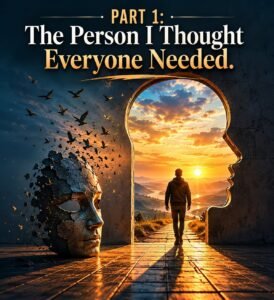
I don’t remember hearing the words “mental health” until I was well into my twenties.
Before that, people were either crazy or they weren’t. At least that’s how it seemed. Nobody talked much about anxiety, trauma, self-esteem, emotional regulation, or any of the language that’s common today. If someone was struggling, they were expected to deal with it. If someone couldn’t cope, people whispered about them. The conversation rarely went any deeper than that.
As a result, I spent a large portion of my early life completely unaware of what was happening inside my own head.
Like many young people, I had insecurities. I had fears, doubts, and habits that made very little sense. I engaged in self-destructive behaviors from time to time and pursued things I knew weren’t good for me and looking back, what strikes me most isn’t the behavior itself.
It’s how little curiosity I had about it. I never stopped to ask why I was making certain decisions or why I kept repeating the same patterns. I simply assumed that’s who I was.
The truth was I’d become very skilled at adapting.
I grew up in a household where inconsistency was often the only thing that felt predictable. The emotional weather would change quickly, and like many children in similar environments, I became a careful observer. I paid attention to moods. I watched people’s reactions. I
learned to recognize subtle shifts in behavior long before I understood why I
was doing it.
At the time, it felt like survival.
Looking back now, I can see much of my emotional well-being depended on my ability to understand what other people needed from me. If someone needed agreement, I could provide it. If they needed support, I could provide that too. If they needed humor, understanding, patience, or reassurance, I would often find a way to become whatever seemed necessary.
I didn’t think of it as pretending…I thought I was being a good person.
The problem was I’d become so focused on understanding everyone else that I never learned much about myself. My attention was always directed outward. I was constantly scanning the environment, trying to determine what would create connection, approval, or acceptance. Over time, that way of living became automatic.
Years later, I would learn there’s a name for this. It’s called people-pleasing.
When I first heard the term, I resisted it. Like most labels, it felt too simple. It sounded like something other people did. Eventually, however, I began recognizing pieces of myself in the description. I realized many of my decisions weren’t being guided by what I wanted, believed, or needed. They were being guided by what I thought would keep my relationships intact.
I know now I’m hardly unique in that regard.
Most people adapt to some degree. We all learn which parts of ourselves are welcomed and which parts create friction. We all make compromises to fit into families, friendships, workplaces, and communities. It’s part of being human. The problem begins when adaptation slowly becomes identity.
That’s what happened to me.
Without realizing it, my self-esteem became tied to approval. The better I became at meeting other people’s expectations, the more valuable I felt. The more useful I was, the more secure I became. It seemed like a reasonable arrangement at the time because it worked often enough to reinforce itself.
What I didn’t understand was this way of living would eventually pull me toward people and situations that weren’t always healthy for me.
When your sense of worth depends on acceptance, you tend to seek acceptance where it’s easiest to find. Sometimes that’s in healthy relationships. Sometimes it isn’t. If you walk into a room full of people looking for escape, distraction, or self-destruction, it’s surprisingly easy to become part of the furniture. In fact, if you’re willing to dislike yourself more than anyone else in the room, you usually fit right in.
I’ve spent a lot of time thinking about that over the years.
Not with shame or regret.
Mostly with curiosity.
Because the older I get, the more I realize many of the behaviors we criticize in ourselves began as solutions. Imperfect solutions, certainly, but solutions nonetheless. They helped us navigate circumstances we didn’t completely understand. They allowed us to survive situations we weren’t equipped to control.
But the challenge comes later.
At some point, our survival strategies outlive the circumstances that created them. What once protected us begins limiting us.
What once helped us belong starts preventing us from growing and what once felt necessary begins feeling heavy.
I didn’t understand that when I was younger.
All I knew was I’d become very good at being whoever I thought other people needed.
It would take me years to ask a much more important question.
Who was I when nobody needed anything at all?
Part 2: The Masks I Didn’t Know I Was Wearing

After spending so many years trying to become the person I thought everyone needed, something interesting began to happen.
I became good at it.
If I was around people who valued toughness, I became tougher. If I was around people who valued humor, I became more entertaining. If I found myself among people who were angry, cynical, rebellious, or self-destructive, I could usually find a way to fit in there too. I had spent so much of my childhood trying to read the room that eventually it became second nature.
The strange thing is that most people rewarded me for it.
People generally enjoy being around people who make them feel understood. They enjoy familiarity. They enjoy seeing parts of themselves in other people. Because I had become skilled at adapting, I often found it relatively easy to build relationships and find acceptance.
At least on the surface.
What I couldn’t see at the time was that every adaptation came with a cost. The more energy I invested in becoming what others expected, the less time I spent figuring out who I was. I had become so focused on fitting into different environments that I rarely stopped to ask whether those environments were good for me in the first place.
That realization took years to emerge.
For a long time, I assumed my ability to blend in was a strength. In some situations, it probably was. The ability to understand different people and adapt to changing circumstances can be useful. The problem arises when adaptation becomes your default setting. If you’re constantly adjusting yourself to fit the expectations of others, eventually it becomes difficult to separate your own identity from the roles you’re performing.
Looking back, I can see examples of this throughout my life.
I found myself in friendships that weren’t particularly healthy because belonging felt more important than honesty. I stayed in situations longer than I should have because conflict made me uncomfortable. I tolerated behavior that wasn’t in my best interest because acceptance often felt easier than authenticity.
None of this happened consciously.
That’s what makes these patterns so difficult to recognize. We rarely wake up and decide to abandon ourselves. Instead, it happens gradually. One compromise here. One adjustment there. A small piece of us traded for approval. Another traded for belonging. Eventually the pattern becomes so familiar that we stop noticing it altogether.
The older I get, the more I think many people do some version of this. Human beings are social creatures. We want connection. We want acceptance. We want to feel like we belong somewhere. There is nothing wrong with those desires. In many ways, they’re essential to being human.
The challenge comes when belonging becomes more important than authenticity.
For me, that line became blurry. I had spent so much time trying to understand what other people wanted from me that I had very little practice understanding what I wanted from myself. If someone had asked me who I really was beneath all the roles I played, I’m not sure I could have answered them.
I knew how to be useful or agreeable. I knew how to be whatever the situation required. What I didn’t know was who remained when nobody else was around.
That question began following me as I moved through adulthood. At first, it appeared only occasionally, usually during quiet moments when there was nobody to impress and nothing to accomplish. Then it started showing up more often. I would find myself wondering why certain achievements felt hollow or why certain relationships left me feeling disconnected despite appearing successful from the outside.
Something wasn’t adding up.
From the outside, much of my life looked perfectly normal. I was doing many of the things people are supposed to do. Yet there was a growing sense that I was living according to a script I had never consciously chosen. I had become skilled at playing roles, but I wasn’t entirely sure who the actor was underneath them.
That realization was uncomfortable because it challenged an identity I had spent decades constructing. If the masks weren’t really me, then who was? If this much of my behavior was driven by approval, belonging, and adaptation, what did I really believe? What values were genuinely mine, and which ones had simply been absorbed from the people and environments around me?
Those questions didn’t arrive with immediate answers.
If anything, they created more questions. Yet for the first time in my life, I found myself becoming curious about the person beneath the performance. Not the version that other people needed. Not the version that earned approval. Not the version that fit neatly into different groups.
The person underneath all of it.
As uncomfortable as that process became, it eventually led me toward an even deeper realization. The masks themselves weren’t the real story. They were symptoms of something underneath. Hidden beneath those roles were beliefs and assumptions that had been quietly shaping my life for years.
And most of them weren’t even mine.