
Understanding Systems
Introduction:
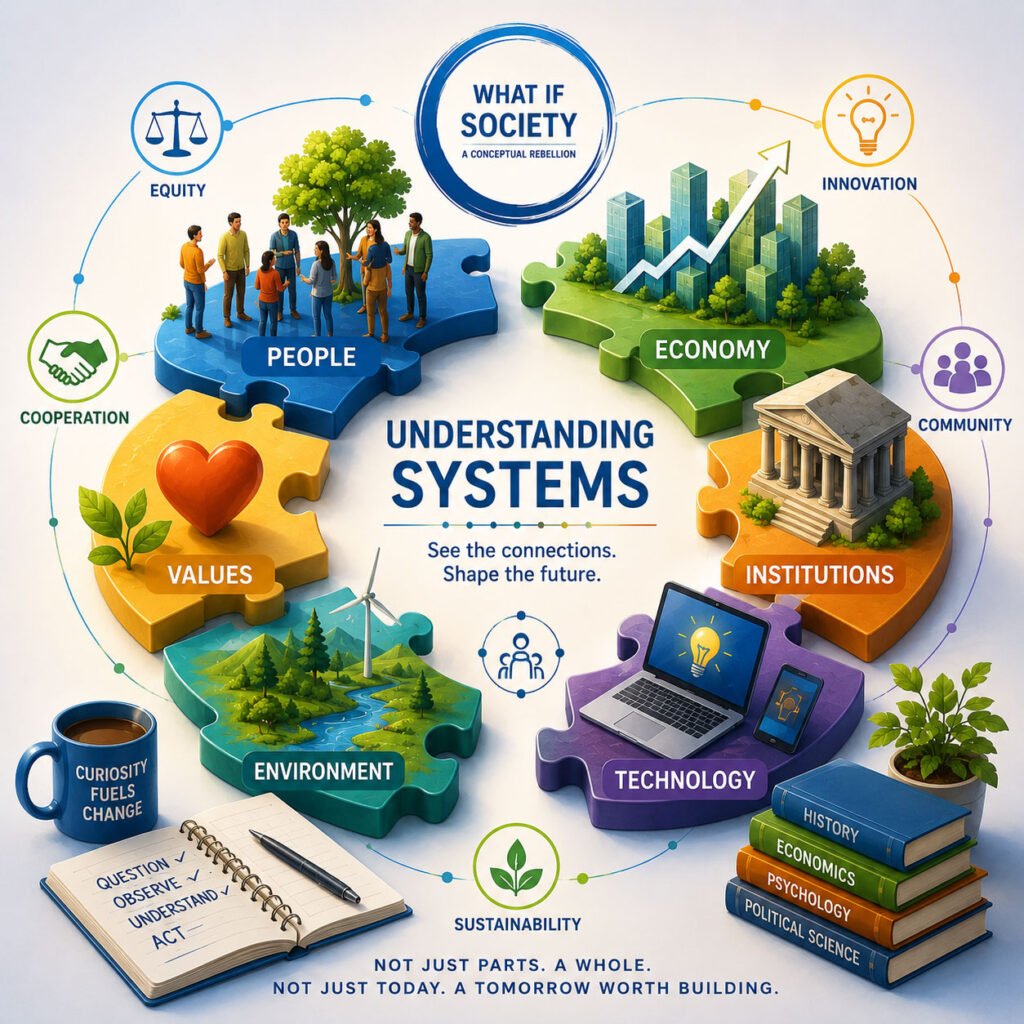
If the last section was about understanding ourselves, this one is about understanding the systems that shape our lives.
I didn’t arrive there intentionally. I wasn’t setting out to question governments, economies, or institutions. I was simply trying to understand myself. But as I began looking more honestly at where my own beliefs came from, I realized many of them weren’t entirely mine. They had been passed down by my family, my teachers, my community, and the culture I was randomly born into. That’s true for all of us. Every generation inherits a story about the world before it’s had a chance to write its own. The question remains whether we’ll ever stop long enough to ask which parts of the story still make sense.
For me, that process really began in 1987 when I walked into my first Political Science class.
I grew up in a town of fewer than 900 people, so college felt like another world. My instructor wasn’t much older than the rest of us, but he taught in a way I’d never experienced before. He didn’t care if we memorized theories. He wanted us to challenge them. We spent as much time looking for contradictions as we did learning the official doctrines, and somewhere along the way I realized he wasn’t really teaching politics. He was teaching us how to think about systems.
That lesson stayed with me.
We studied monarchies, democracies, socialism, communism, fascism, and almost all other political system people have imagined. On paper, they all promised something worthwhile: freedom, justice, equality, prosperity, stability, or security. Yet history rarely unfolded the way those promises suggested. Time after time, noble ideas collided with bureaucracy, ambition, corruption, fear, and the simple reality that human beings don’t stop being human just because they create a new system.
During the first week of class, our instructor asked a question that seemed almost too simple.
“What is the one characteristic every government has in common?”
The room filled with answers. Laws. Taxes. Armies. Elections.
Then he smiled and offered his own.
“Every government must expand to maintain its power and legitimacy.”
Whether that’s always true is something people can debate, and I suspect they always will. That wasn’t really the point. What mattered was that our instructor invited us to question the idea instead of accepting it because an authority had said it. He wasn’t asking us to agree with him. He was asking us to observe, think, and decide for ourselves.
That planted a seed of skepticism in me and freed me from my cynicism.
I’ve come to believe there’s an important difference. Cynicism assumes it already knows the answer and usually expects the worst. Skepticism keeps asking questions because it accepts that none of us sees the whole picture. One closes the conversation. The other keeps it alive.
Over the years, I found myself becoming less interested in defending one ideology over another and more interested in looking for patterns. Different countries, different parties, different leaders, yet many of the same problems seemed to appear. Institutions created to solve problems often became focused on preserving themselves. Bureaucracies grew. Power had a habit of concentrating. That doesn’t mean every institution is corrupt or every government is destined to fail. It simply raises a question worth asking: are these failures accidents, or are they incentives built into the systems themselves?
I noticed something else as the years went by. Every generation edits its understanding of history. Sometimes that’s because scholarship improves and we gain a clearer picture of the past. Sometimes language evolves and old labels no longer fit. But I also wonder whether certain questions quietly become unfashionable. I don’t pretend to know where that line is. What matters to me is that people remain free to ask uncomfortable questions without assuming the questions themselves are dangerous.
A healthy society shouldn’t fear curiosity. If an idea is sound, honest scrutiny will make it stronger. If it falls apart the moment it’s questioned, perhaps it wasn’t as solid as we believed. Either way, asking better questions moves us closer to understanding.
That’s what this next part of the journey is about.
We’ll spend less time looking inward and more time exploring the systems we’ve built together—our political institutions, economic models, financial structures, technologies, media, and the organizations that quietly influence the way we think and live. None of them appeared by accident. Human beings created them, which also means human beings can improve them.
Understanding ourselves was the beginning.
Understanding the systems we’ve inherited is the next step. And if enough of us understand both, perhaps we’ll discover that the future isn’t something we’re simply waiting for. It’s something we’re already building, whether we realize it or not.
What If Capitalism Isn't What We Think It Is?
One of the most interesting lessons I learned studying political and economic systems is that people often spend more time arguing about labels than understanding what those labels mean. Few words illustrate this better than capitalism. Depending on who you ask, capitalism is either the greatest engine of prosperity ever created or the root cause of many of society’s problems. The debate is usually passionate, but it often skips over an important question: are we all talking about the same thing?
At its simplest, capitalism is an economic system built around private ownership, voluntary exchange, competition, and the idea that individuals should be free to pursue opportunities in the marketplace. The theory is straightforward. Businesses compete for customers, consumers choose the products and services they value most, and innovation is rewarded. Many of the technologies, medicines, conveniences, and improvements in living standards that people enjoy today emerged within capitalist economies. It is difficult to deny that capitalism has played a significant role in generating wealth and raising material living standards for millions of people around the world.
Yet when people criticize capitalism, they are often not criticizing this idealized version. They are criticizing the system they experience in everyday life. They see corporations receiving government subsidies while small businesses struggle to survive. They see financial institutions rescued when they make poor decisions while ordinary citizens absorb the consequences. They see housing becoming less affordable, wealth becoming more concentrated, and political influence increasingly tied to economic power. To many critics, this does not look like a free market. It looks like a system in which large institutions have advantages that are unavailable to everyone else.
This is where the conversation becomes interesting. If a company succeeds because it creates a better product, many people view that as capitalism working as intended. If a company succeeds because it can influence regulations, secure special treatment, or limit competition, the picture becomes less clear. The line between free enterprise and political influence can become difficult to distinguish. As a result, supporters and critics often end up debating different systems while using the same word.
What I find most fascinating is that capitalism, like many systems we’ll explore, reflects human nature as much as economic theory. Markets reward creativity, initiative, and risk-taking, but they can also reward short-term thinking, consolidation of power, and the pursuit of profit above all else. The system itself does not create virtue or vice. It amplifies qualities that already exist within the people participating in it.
Perhaps the most useful question is not whether capitalism is good or bad. Very few systems are entirely one thing or the other. A better question might be whether our current economic arrangements are delivering the outcomes we claim to value. Are they encouraging innovation and opportunity? Are they supporting healthy communities? Are they creating pathways for young people to build meaningful lives? The answers will vary depending on who you ask, but asking those questions is far more productive than defending or attacking a label.
Understanding capitalism begins by looking beyond the rhetoric. Only then can we begin to distinguish between the ideals a system promises and the realities it produces.
What If Socialism Isn't What We Think It Is?
If capitalism is one of the most debated words in politics, socialism is probably a close second. For some people, socialism represents fairness, cooperation, and a society that takes care of its most vulnerable citizens. For others, it represents government control, economic inefficiency, and a loss of individual freedom. Like capitalism, socialism often generates strong reactions long before people stop to define what they mean by it.
At its core, socialism emerged as a response to problems created during the Industrial Revolution. As factories grew and wealth accumulated in the hands of relatively few people, many workers faced difficult conditions, low wages, and little economic security. Socialists argued that an economy should be organized to serve society rather than primarily benefiting the owners of capital. Different versions of socialism proposed different solutions, but most shared a common concern: how do we distribute the benefits of economic activity more fairly?
The interesting thing is that many people living in modern democracies already support some ideas that originated from socialist thinking. Public education, public healthcare, workplace safety regulations, unemployment insurance, pensions, and social assistance programs are often rooted in the belief that society has some responsibility to support its members. Even countries that are considered strongly capitalist typically include elements of socialism within their economic systems. In practice, most modern societies operate somewhere between pure capitalism and pure socialism.
When critics attack socialism, however, they’re usually thinking about something different. They point to historical examples where governments gained extensive control over economic activity, restricted political freedoms, and concentrated power within the state. In these cases, the promise of equality sometimes led to shortages, inefficiencies, corruption, and limited personal freedoms. Critics argue that when governments attempt to manage too much of the economy, innovation and individual initiative can suffer.
Supporters respond these failures do not necessarily invalidate every socialist principle. They point out that markets alone do not always address healthcare, housing, education, environmental protection, or poverty effectively. Left entirely on their own, markets may generate wealth while leaving significant social challenges unresolved. From this perspective, socialism is less about government control and more about ensuring that economic prosperity benefits society broadly rather than concentrating it exclusively among people who already possess wealth and influence.
Something I find interesting is the debate most often becomes focused on labels. People defend or attack socialism as though it were a single, fixed idea, when it exists along a spectrum of policies and philosophies. A person can support entrepreneurship and markets while also believing healthcare should be universally accessible. Another person can support strong social programs while remaining skeptical of government bureaucracy. Real-world societies are rarely as ideological as the arguments surrounding them.
Perhaps the most important question is not whether socialism is good or bad. The more useful question may be what problems socialism was attempting to solve in the first place. Understanding those problems helps us understand why socialist ideas continue to attract support even after their shortcomings have been exposed. Like every political and economic system, socialism reflects humanity’s ongoing attempt to balance freedom, security, opportunity, and fairness. The challenge is that those goals do not always align perfectly, and every solution creates trade-offs that future generations must continue to navigate.
What If Communism Isn't What We Think It Is?
Few political ideas generate stronger reactions than communism. For many people, the word immediately suggests authoritarian governments, economic shortages, political repression, and some of the darkest chapters of the twentieth century. For others, communism began as an idealistic attempt to create a society free from extreme inequality, exploitation, and class divisions. Like capitalism and socialism, communism is often discussed through the lens of its successes or failures without first examining the ideas that inspired it.
The roots of communism can be traced to the work of figures such as Karl Marx and Friedrich Engels, who argued that economic systems shape much of human society. They believed that history was largely driven by conflicts between social classes and that capitalism would eventually concentrate wealth and power in the hands of a small ownership class. Their proposed solution was a society where the means of production were collectively owned and where class distinctions would gradually disappear. In theory, communism envisioned a world in which resources were distributed according to need rather than accumulated according to wealth or ownership.
When many people hear this description, they are often surprised by how different it sounds from the historical examples they associate with communism. The original vision was not simply about state control. It was about creating a classless society where economic exploitation no longer existed. Whether that vision was realistic is a separate question, but understanding the goal helps explain why the idea attracted millions of supporters throughout the world.
The challenge arose when communist movements attempted to transform theory into reality. In countries such as Soviet Union and People’s Republic of China, governments often centralized economic and political power in the name of achieving equality. While these systems sometimes achieved rapid industrialization, expanded literacy, and improved access to basic services, they also produced significant problems. Concentrated political power often limited freedom of expression, reduced political competition, and created bureaucracies that struggled to respond effectively to changing economic conditions.
Critics argue that these outcomes were not accidental but reflected a deeper problem within communism itself. They contend that concentrating economic authority inevitably concentrates political authority as well, making abuses of power difficult to prevent. Supporters sometimes respond that many historical communist states departed from the original vision and that external pressures, wars, and geopolitical conflicts also shaped their development. The debate continues because people disagree not only about the results but also about the reasons behind them.
What interests me most is that communism emerged from concerns that remain relevant today. Questions about inequality, worker power, housing affordability, access to resources, and the concentration of wealth continue to influence political debates around the world. Even people who reject communism outright often share some of the concerns that motivated its development. Understanding this distinction is important because it helps separate an idea from its implementation.
Perhaps the most useful question is not whether communism was right or wrong. A better question might be what it was attempting to solve and why so many people found those concerns compelling. Like nearly every political system of its time, communism reflects humanity’s ongoing effort to balance freedom, equality, opportunity, and security. Its history reveals both the appeal of those goals and the difficulties involved in pursuing them. Understanding that tension may teach us more than simply accepting or rejecting a label.
What If Democracy Isn't What We Think It Is?
If there is one political system that most people in the Western world rarely question, it is democracy. We are taught that democracy represents freedom, self-government, and the right of citizens to determine their collective future. For many people, it is considered the highest form of political legitimacy because leaders derive their authority from the consent of the governed rather than inheritance, force, or divine right. Yet like every system we’ve explored, democracy may be more complicated than the stories we tell about it.
At its core, democracy is built on a simple idea: political power ultimately belongs to the people. Citizens participate in public life, elect representatives, and help shape the direction of their societies. Compared to many alternatives throughout history, democracy has produced remarkable benefits. Democratic societies have often provided greater protections for individual rights, more peaceful transfers of power, and greater opportunities for public participation. These achievements should not be dismissed lightly. They represent centuries of political development and hard-won reforms.
The interesting question is not whether democracy has value. The question is whether modern democracies always function the way people imagine they do. Many citizens grow up believing that voting is the primary mechanism through which public priorities are translated into government action. Over time, however, some notice a gap between public opinion and political outcomes. They observe lobby groups, political parties, large donors, media organizations, bureaucracies, and economic interests all competing to influence decision-making. As a result, some people begin to wonder how much influence ordinary citizens possess between election cycles.
Supporters of democracy would argue these imperfections are not evidence of failure but evidence of complexity. Governing millions of people with different values, priorities, and interests is an extraordinarily difficult task. Compromise is unavoidable. Decisions that satisfy one group may disappoint another. Democracies are rarely efficient because they are designed to balance competing interests rather than impose a single vision. From this perspective, frustration with democracy may reflect unrealistic expectations rather than flaws in the system itself.
Critics, however, often point to a different concern. They argue that democratic systems can become increasingly managed by professional political classes, permanent bureaucracies, powerful economic interests, and media narratives that shape public perception. In this view, citizens are encouraged to participate periodically while many important decisions remain concentrated within institutions that are difficult to influence directly. Whether one agrees with this criticism or not, it reflects a concern that democracy may sometimes become more procedural than participatory.
What fascinates me most is that democracy depends upon something deeper than elections. It depends upon citizens. A democratic constitution can exist on paper, but its long-term health relies on people who are informed, engaged, and willing to participate in public life. When citizens become disengaged, cynical, or unwilling to examine their own assumptions, democratic institutions often weaken regardless of how well they are designed.
Perhaps the most useful question is not whether democracy works perfectly. No political system does. A more important question may be what kind of citizens democracy requires to function well. The answer may involve curiosity, responsibility, critical thinking, and a willingness to engage with people who see the world differently. Democracy is often described as government by the people, but its success may depend less on the structure itself and more on the qualities of the people who participate within it. Understanding that distinction may help us think more carefully about both the strengths and limitations of the system we often take for granted.
What If Monarchy Isn't What We Think It Is?
When most people hear the word monarchy, they picture kings, queens, castles, crowns, and royal families. To many modern citizens, monarchy feels like a relic of the past, a political system left behind as societies embraced democracy and representative government. It is often portrayed as the opposite of freedom because power is inherited rather than earned through elections. Yet like every political system we’ve explored, monarchy is more complicated than the stereotypes surrounding it.
For most of human history, monarchy was the dominant form of government. Long before political parties, constitutions, and elections became common, societies needed ways to organize leadership, resolve disputes, collect resources, and defend themselves. In many cases, monarchy emerged because people believed stability was more important than political participation. A clear line of succession reduced uncertainty and helped prevent constant struggles over who should govern. While this did not eliminate conflict, it often provided continuity in a world where survival was far less certain than it is today.
The traditional justification for monarchy was straightforward. If a ruler expected to pass a kingdom on to future generations, they would have a long-term interest in its prosperity and stability. A monarch did not need to win elections every few years, raise campaign funds, or constantly appeal to public opinion. In theory, this allowed rulers to focus on long-term decisions rather than short-term political pressures. Some monarchs became highly effective administrators, reformers, and nation-builders. Others became symbols of corruption, incompetence, or tyranny. As with every system, outcomes depended heavily on the people operating within it.
When critics discuss monarchy, they usually focus on its obvious weaknesses. The most significant is that leadership is determined by birth rather than ability. A wise ruler may be followed by an ineffective heir. Citizens have little direct influence over succession, and there are few guarantees that inherited power will be exercised responsibly. History contains many examples of monarchs whose decisions led to war, oppression, economic decline, or political instability. These failures helped inspire movements that sought to replace hereditary rule with systems based on representation and consent.
Yet what I find interesting is that many criticisms of monarchy are not unique to monarchy. Modern democracies often develop political families, powerful elites, and institutions that persist across generations. Wealth, influence, education, and social connections can still affect who gains access to power. While democratic systems provide citizens with more direct participation, they do not eliminate hierarchy or unequal influence. The methods differ, but the challenge of balancing power and accountability remains.
Today, most monarchies that survive are constitutional monarchies, where elected governments exercise most political authority while monarchs serve primarily ceremonial and symbolic roles. In countries such as Canada and United Kingdom, monarchies often function less as governing institutions and more as symbols of continuity, tradition, and national identity. Supporters argue that these institutions provide stability above partisan politics. Critics question whether hereditary positions remain relevant in modern societies that emphasize equality and merit.
Perhaps the most useful question is not whether monarchy is good or bad. A more interesting question is why it endured for so much of human history and why some forms of it continue today. Like every political system, monarchy emerged in response to specific challenges and reflected certain assumptions about leadership, authority, and stability. Understanding those assumptions helps us see monarchy not simply as an outdated institution, but as one chapter in humanity’s ongoing effort to answer a difficult question: who should govern, and how should power be exercised responsibly?
What If Fascism Isn't What We Think It Is?
Few political words are used more often—or understood less consistently—than fascism. In everyday conversation, the term is frequently applied to political opponents, unpopular policies, censorship, authoritarian behavior, or almost anything perceived as oppressive. The result is that fascism has become as much an insult as a political concept. Yet if we want to understand history and modern politics, it helps to separate the label from the emotion surrounding it.
Historically, fascism emerged during the early twentieth century, most notably in Italy under Benito Mussolini and later in a different form in Germany under Adolf Hitler. While scholars continue to debate the precise definition, fascism generally involved intense nationalism, centralized authority, the subordination of individual interests to the perceived needs of the nation or state, and the belief that society should be unified behind a common purpose. Fascist movements often rejected both liberal democracy and Marxist communism, viewing political disagreement and competing interests as sources of weakness rather than healthy features of society.
One reason fascism remains difficult to discuss is that it rarely presented itself as tyranny. Like most political movements, it offered a vision of renewal. It promised unity, purpose, stability, national strength, and a solution to social and economic disorder. Many people were attracted to these promises during periods of political instability, economic hardship, and cultural uncertainty. Understanding this does not excuse the outcomes, but it helps explain why such movements gained support in the first place. Political systems are rarely adopted because people desire oppression; they are usually adopted because people believe they will solve existing problems.
When critics warn about fascism today, they often focus on patterns rather than exact historical repetition. They point to the concentration of power, hostility toward dissent, the use of fear to mobilize support, the elevation of group identity over individual rights, and the tendency to portray political opponents as enemies rather than fellow citizens. These concerns are not unique to any single ideology. Throughout history, movements from different parts of the political spectrum have sometimes displayed authoritarian tendencies when convinced that their goals justified extraordinary measures.
What I found most interesting when studying political systems was not how different they claimed to be, but how often they struggled with similar human weaknesses. Fear, insecurity, tribal loyalty, and the desire for certainty can appear in almost any system. The symbols, slogans, and justifications may change, but the underlying human impulses remain remarkably familiar. This is one reason scholars often focus less on labels and more on behaviors. A society does not become healthier simply because it adopts the right language. What matters is how power is exercised, how disagreement is treated, and whether citizens retain the freedom to question those who govern them.
Perhaps the most useful question is not whether fascism belongs exclusively to the political left or right, or whether it could return in the same form. A more productive question may be what conditions allow authoritarian tendencies to grow within any society. Understanding those conditions requires looking beyond slogans and examining human behavior itself. Like every system we have explored, fascism reminds us that political institutions are ultimately reflections of the people who create and sustain them. The lesson may be less about a particular ideology and more about the importance of preserving the habits, freedoms, and responsibilities that allow societies to remain open.
What If Nationalism Isn't What We Think It Is?
One of the things that surprised me when I first started studying political systems was how often people argued about ideas they defined differently. Nationalism is a good example. For some people, nationalism means loving your country, preserving your culture, and feeling connected to the people around you. For others, it represents division, exclusion, and conflict. Depending on who is using the word, nationalism can sound either noble or dangerous.
What interested me wasn’t who was right. It was why the idea seemed to resonate with so many people.
The older I get, the more I think nationalism begins with something very human. Most of us want to belong to something larger than ourselves. We want roots. We want a story. We want to feel connected to a place, a history, and a community. For many people, their nation provides that connection. It becomes part of how they understand themselves and their place in the world.
In that sense, nationalism is not particularly unusual. We identify with families, neighbourhoods, professions, religions, sports teams, and communities. National identity is simply one more layer of belonging. It can inspire people to work together, support one another, and make sacrifices for a common purpose. Many countries were built because groups of people wanted the ability to govern themselves and preserve their way of life. Without some sense of shared identity, creating stable societies can be difficult.
The challenge is that belonging has a shadow side. The same instinct that helps us form communities can also encourage us to draw lines between “us” and “them.” History provides countless examples of national pride becoming national superiority, and national loyalty becoming hostility toward outsiders. The problem is not that people care about their country. The problem emerges when that attachment becomes so strong that it overshadows our ability to recognize the humanity of people who belong to different groups.
It’s interesting that nationalism often reflects a tension that exists within all of us. We are local and global at the same time. We care about our families, communities, and countries, yet we also live in a world where events occurring thousands of miles away can affect our daily lives. We can feel pride in our heritage while recognizing other people feel the same way about theirs. Balancing those realities is not always easy.
This is one reason nationalism continues to generate debate. Supporters often see it as a source of cohesion, stability, and cultural continuity. Critics worry that it can become exclusionary or resistant to change. Both concerns contain some truth because nationalism, like most political ideas, reflects human strengths and weaknesses rather than existing as purely one thing or another.
The question isn’t necessarily whether nationalism is good or bad. A better question might be how we balance our need for belonging with our responsibility to treat others with dignity and respect. Nations matter. Communities matter. Shared identities matter. But so does our ability to see beyond them.
The more I study political systems, the less interested I become in labels and more interested in the human needs beneath them. Nationalism endures because it speaks to something many people are searching for: connection, identity, and belonging. Understanding that may be more important than arguing over the word itself.
Globalism: What If Cooperation Creates New Problems?
When I was younger, global cooperation seemed like an obvious good. If countries could trade more, communicate more, and work together more effectively, surely the world would become more peaceful and prosperous. On the surface, the idea made perfect sense. After all, many of the challenges we face don’t stop at national borders. Pollution, financial crises, pandemics, migration, technological change, and international conflict affect people regardless of where they live. Cooperation appeared to be the logical response.
In many ways, it has been. Global trade has connected markets and lifted millions of people out of poverty. Advances in communication have allowed people from different cultures to exchange ideas and knowledge on a scale no one could imagine 100 years ago. International institutions have helped coordinate responses to complex problems that no single nation could address alone. Viewed from this perspective, globalism is not a conspiracy or an ideology so much as a recognition that the world has become increasingly interconnected.
What’s interesting however, is the solutions often create new challenges of their own. The same economic integration that creates prosperity can also make communities feel vulnerable when industries relocate or supply chains break down. The same technologies that connect people across continents can weaken local relationships and traditions. The same institutions designed to coordinate international cooperation can sometimes appear distant from the citizens affected by their decisions. As systems grow larger, people often feel less connected to them.
This tension may explain why debates about globalism have become so emotional. Supporters often emphasize the benefits of cooperation and interdependence. Critics tend to focus on questions of accountability, sovereignty, and local control. Both perspectives are responding to something real. Most people appreciate the benefits of living in a connected world, yet many also want decisions affecting their lives to remain understandable, accessible, and accountable. The challenge is finding a balance between those goals.
The older I get, the more I notice that scale changes everything. A small community can rely heavily on personal relationships because people know one another. Large national institutions require rules and bureaucracy because personal relationships are no longer sufficient. International organizations face an even greater challenge. The farther decisions move from the people affected by them, the more difficult it becomes to maintain trust and legitimacy. This does not mean larger systems are inherently bad, but it does mean they face problems that smaller systems often avoid.
What fascinates me is the debate about globalism is often presented as a choice between cooperation and independence when reality is more complicated. Nations need each other. Communities need nations. Individuals need communities. Human beings seem to function best when multiple levels of cooperation exist simultaneously. The question is not whether we should cooperate. We always will. The question is how cooperation can occur without concentrating too much power too far from the people it serves.
Perhaps the most useful question is not whether globalism is good or bad, the better question might be how we preserve the benefits of cooperation while maintaining accountability, local identity, and meaningful participation. Like many political ideas, globalism emerged in response to real problems. Understanding its strengths requires acknowledging its achievements. Understanding its weaknesses requires recognizing that every solution creates trade-offs. The challenge for future generations may be learning how to cooperate at a global scale without losing sight of the human beings those systems are meant to serve.
Technocracy: What If Experts Rule the World?
Another interesting political idea I encountered while studying systems of government wasn’t democracy, socialism, or capitalism. It was technocracy. The basic idea sounds simple enough: if society faces increasingly complex challenges, shouldn’t the people making important decisions be those with the greatest expertise? Instead of relying primarily on politicians, public opinion, or competing ideologies, a technocratic system places significant trust in scientists, engineers, economists, and other specialists to guide decision-making.
At first glance, the idea has a certain appeal. Modern societies are extraordinarily complicated. Energy systems, financial markets, healthcare networks, telecommunications, transportation, artificial intelligence, and environmental management all require specialized knowledge. Most citizens cannot be experts in every field, and most elected officials rely heavily on advisors to help them understand the issues they face. In many ways, modern governments already contain elements of technocracy because expertise is necessary to operate large and complex institutions.
Supporters of technocratic approaches often argue that evidence should matter more than ideology. They point out that engineers generally understand bridges better than politicians, doctors understand medicine better than public commentators, and scientists understand scientific research better than social media influencers. From this perspective, decisions grounded in data, evidence, and professional knowledge may produce better outcomes than decisions driven primarily by emotion, popularity, or political incentives.
The challenge begins when expertise and authority become difficult to separate. Knowing how something works is not always the same as knowing what should be done about it. An economist may understand the likely consequences of a policy, but citizens may still disagree about whether those consequences are desirable. A scientist may identify risks but deciding how much risk society is willing to accept often involves values as much as facts. Expertise can inform decisions, but it cannot completely replace public judgment.
This is where I think the discussion becomes even more interesting. Throughout history, many political systems have struggled with the same question: who should decide? Monarchies placed trust in hereditary rulers. Democracies place trust in citizens and representatives. Technocracy places greater trust in expertise. Each approach solves certain problems while creating new ones. A society governed entirely by public opinion can make poorly informed decisions. A society governed entirely by experts may become disconnected from the people it serves.
The older I get, the more I appreciate expertise while also recognizing its limitations. Some of the smartest people I’ve encountered possessed tremendous knowledge within their fields but disagreed strongly with one another about broader social questions. Expertise often provides better information, but it does not eliminate uncertainty, competing values, or human bias. Experts are still people. They have assumptions, incentives, blind spots, and disagreements just like everyone else.
What fascinates me is that technocracy reflects a very human desire for certainty. We often hope that somewhere there are people smart enough to solve our problems if only they were given enough authority. Sometimes expertise genuinely improves outcomes. Sometimes it doesn’t.. But the more closely I study political systems, the more I suspect that knowledge alone is not enough. Healthy societies require expertise, but they also require accountability, transparency, participation, and public trust.
Perhaps the most useful question is not whether experts should have influence. Clearly, they should. A better question might be how expertise can inform decision-making without replacing the role of citizens altogether. Like many systems we’ve explored, technocracy reminds us that there is often a difference between solving technical problems and navigating human ones. The future may depend less on choosing between expertise and participation than on learning how to balance both.
The Administrative State: What If No One Is Actually in Charge?
When people become frustrated with government, they often direct that frustration toward politicians. Prime ministers, presidents, premiers, cabinet ministers, and elected officials tend to receive most of the attention because they are the public face of political power. It’s easy to imagine these individuals are steering the ship and determining the direction of society. The more I studied political systems, however, the more I began to wonder whether that picture was entirely accurate.
Modern governments are enormous organizations. They manage transportation systems, healthcare networks, regulatory agencies, tax collection, public safety, environmental oversight, international agreements, social programs, and countless other responsibilities. No elected official, regardless of intelligence or experience, could personally oversee all these functions. As governments grow more complex, much of the actual work is performed by permanent institutions staffed by civil servants, regulators, policy experts, lawyers, administrators, and specialists whose careers often span multiple political administrations.
This reality gave rise to what many people refer to as the administrative state. The term generally describes the collection of agencies, departments, and bureaucratic institutions that continue operating regardless of which political party wins an election. These organizations provide continuity and expertise. They preserve institutional knowledge, administer programs, enforce regulations, and help governments function from one election cycle to the next. Without them, modern societies would struggle to operate effectively.
Supporters argue that the administrative state exists because complexity requires specialization. Most citizens would not expect elected officials to personally inspect bridges, certify pharmaceuticals, monitor air traffic, regulate financial institutions, or oversee nuclear facilities. Governments rely on experts because modern life depends upon expertise. From this perspective, bureaucracy is not evidence of corruption or dysfunction. It is a practical response to the demands of governing large and technologically advanced societies.
Yet this is also where concerns begin to emerge. As institutions become larger and more specialized, decision-making can become difficult for ordinary citizens to understand. Policies may be shaped by agencies few people have heard of. Regulations may be written by experts who are largely unknown to the public. Citizens vote for elected officials, but much of the implementation occurs within systems that remain in place regardless of election results. This can create the impression that governments continue moving in roughly the same direction no matter who is elected.
What fascinates me is that the administrative state challenges some of our assumptions about political power. Many people imagine government as a hierarchy with clear lines of authority. In reality, power can be distributed across thousands of organizations, committees, agencies, and institutions that interact in complicated ways. Decisions emerge from processes rather than individuals. Responsibility becomes difficult to trace because no single person is controlling the entire system.
The older I get, the less convinced I am that most societies are run by secret groups pulling hidden strings. More often, they appear to be governed by large networks of institutions attempting to manage complexity. That does not mean these institutions are always effective, accountable, or responsive. It simply means that the reality may be less dramatic and more complicated than many people imagine.
Perhaps the most useful question is not whether the administrative state is good or bad. A better question might be how large institutions can remain accountable to the people they serve. Every society requires expertise, continuity, and administration. At the same time, citizens want transparency, responsiveness, and meaningful participation. Balancing those goals may be one of the most important challenges facing modern democracies. The question is not necessarily who is in charge. It may be whether anyone fully understands the systems that increasingly shape our lives.
The Central Banking System: What If Money Is a Rulebook?
For most of my life, I didn’t spend much time thinking about money. Like many people, I thought about earning it, saving it, paying bills with it, and mostly wishing I had more of it. The system itself seemed distant and complicated. Banks existed. Interest rates went up and down. Economies expanded and contracted. It all felt like something handled by experts somewhere far above my pay grade.
That changed when I started looking at economic systems the same way I had learned to examine political systems. Instead of asking whether they were good or bad, I began asking what problem they were trying to solve. The deeper I looked, the more I realized that money is not just a thing. It is a set of rules. In many ways, it functions like a scorekeeping system that helps billions of people cooperate without knowing one another personally.
At the center of most modern monetary systems sits a central bank. Its responsibilities vary from country to country, but central banks generally help manage the money supply, influence interest rates, support financial stability, and respond to economic crises. Supporters argue that these institutions exist because modern economies are too complex to function without some form of coordination. Without mechanisms to manage liquidity, credit, and banking stability, economic disruptions could become far more severe and frequent.
The interesting part is that central banks rarely tell people what to buy, where to work, or how to live. Instead, they influence incentives. Interest rates affect borrowing and saving. Access to credit affects investment and consumption. Inflation changes the purchasing power of money over time. These decisions ripple through society in ways most people never directly observe. Like the rules of a game, they shape behavior without necessarily drawing attention to themselves.
This is why I sometimes think of money as a rulebook rather than a currency. The rules determine what actions are rewarded, which risks become attractive, and how resources move through society. Most people focus on the players. They focus on businesses, governments, consumers, and investors. Far fewer spend time examining the rules that influence how those players behave.
Critics of central banking often argue that these institutions possess too much influence over economies and financial markets. They point to inflation, debt accumulation, asset bubbles, and growing financial complexity as evidence that the system sometimes creates its own problems. Supporters counter that many of these challenges would likely be worse without institutions capable of responding to economic shocks and financial crises. Both perspectives contain elements worth considering because modern economies are extraordinarily difficult to manage.
What fascinates me is how little most citizens are taught about the monetary systems that shape their lives. We spend years learning history, mathematics, and science, yet many people reach adulthood without a clear understanding of how money is created, how credit functions, or why central banks exist. As a result, discussions about economics often become emotional long before they become educational.
Perhaps the most useful question is not whether central banking is good or bad. A better question might be what incentives the system creates and whether those incentives align with the outcomes society hopes to achieve. Every system has rules, whether we notice them or not. The more I studied economics, the more I came to believe that understanding the rulebook matters just as much as understanding the players. If we want to have meaningful conversations about prosperity, inequality, debt, or opportunity, we first need to understand the framework within which those conversations take place.
The Media System: What If Information Is Power?
When I was growing up, information was relatively simple to navigate. There were newspapers, radio stations, magazines, and a handful of television networks. Most people received their news from similar sources, which didn’t necessarily make those sources perfect, but it did create a shared understanding of current events. Two people could disagree about what should be done yet often begin with the same basic set of facts.
That world no longer exists.
Today we live in an environment where information is everywhere. News arrives instantly. Opinions travel across the globe in seconds. Anyone with a smartphone can publish their thoughts to an audience larger than many newspapers could reach a generation ago. In some ways this is remarkable. Knowledge has become more accessible than at any other point in human history. We can learn about almost anything with a few keystrokes.
Yet something unexpected has happened along the way.
Having access to more information did not necessarily make people feel more informed. In many cases, it made them feel overwhelmed.
The more I studied political systems, the more I came to appreciate the role information plays in shaping society. Political power matters. Economic power matters. But information power may be just as important because it influences how people understand reality itself. Before citizens can make decisions about policies, leaders, or institutions, they first need a picture of what is happening around them. The information they receive helps shape that picture.
This doesn’t mean the media tells people what to think. The process is usually more subtle than that. Media organizations, social media platforms, journalists, commentators, influencers, and content creators all make decisions about what deserves attention. They decide which stories are highlighted, which are ignored, and which receive ongoing coverage. These decisions influence not only what people know, but what they believe is important.
What fascinates me is that the modern media environment often rewards attention rather than understanding. Fear, outrage, conflict, and controversy tend to attract audiences more effectively than nuance or complexity. This is not necessarily the result of bad intentions. It may simply reflect human psychology. We naturally pay attention to potential threats. The challenge is that a system optimized for attention can create a distorted picture of reality.
That doesn’t mean the media is dishonest. It means media systems, like all systems, operate according to incentives. They highlight certain aspects of reality while leaving others in the background. Understanding this helped me become less interested in finding the “perfect” source of information and more interested in developing the ability to think critically about all sources.
Perhaps the most useful question is not whether the media is trustworthy or untrustworthy. A better question might be how we consume information in a world where more information exists than any individual could ever process. Every citizen now has a responsibility that previous generations rarely faced. We must learn to distinguish between information and wisdom, between attention and understanding, and between what is happening in the world and what is merely capturing our attention.
If information is power, then learning how to evaluate it may be one of the most important skills for future generations to master.
The Education System: What If School Teaches Yesterday's Answers?
Some of the most important lessons I learned in school weren’t found in a textbook.
When I think back on my education, I don’t remember every historical date, mathematical formula, or scientific principle I was taught. What I remember are the people who encouraged curiosity. The teachers who seemed more interested in helping students think than simply helping them pass a test. One of those teachers was a political science instructor I had in college. He welcomed disagreement, encouraged questions, and challenged us to examine ideas from multiple perspectives. Looking back, I realize he was teaching something much more valuable than political theory. He was teaching us how to learn.
The older I get, the more I appreciate the difference between knowledge and understanding. Knowledge is important. Every generation benefits from the discoveries, mistakes, and experiences of those who came before. Schools play a vital role in preserving and transmitting that knowledge. Without education, societies would be forced to start over every generation.
At the same time, education faces a challenge that no previous generation has encountered on quite the same scale. The world is changing faster than ever before. Technologies appear and disappear. Entire industries evolve within a few years. Information that once took months to locate can now be accessed in seconds. The future many students will inherit is difficult for anyone to predict, including the people responsible for preparing them for it.
That reality has made me wonder whether the most valuable thing schools can teach is not a collection of answers, but a process for exploring questions. Facts matter, but facts alone are not enough. Students need to learn how to evaluate information, identify assumptions, recognize bias, adapt to change, and remain curious when confronted with uncertainty. Those skills remain useful regardless of how much the world changes.
What concerns me is not that schools teach old information. History, literature, mathematics, science, and philosophy all provide foundations that help us understand ourselves and the world around us. The concern is that curiosity can sometimes become secondary to performance. Young people learn to seek the right answer rather than explore possibilities. They learn how to satisfy expectations before they learn how to challenge them.
Perhaps the best teachers understand this instinctively. They know that education is not simply about preparing students for employment, although that matters. It is also about helping people become thoughtful, capable, and engaged human beings. The most influential teachers I encountered were not the ones who seemed to have all the answers. They were the ones who made me realize how many questions remained worth asking.
Curiosity may be the most important subject a school can teach.
If the future is filled with problems that have not yet been solved, then tomorrow will belong not to the people who memorized yesterday’s answers, but to those who remain curious enough to imagine new ones.
Beyond Ideology: What If Every System Is Incomplete?
For most of my life, I’ve been trying to understand why the world so often falls short of its promises.
As far back as I can remember, I noticed a gap between the ideals people talked about and the realities they experienced. Political systems promised freedom. Economic systems promised prosperity. Institutions promised fairness. Yet when I looked closely, every system seemed to struggle in ways its supporters rarely anticipated. As a young man, I assumed this meant we simply hadn’t found the right answer yet. Somewhere, I believed, there must be a political philosophy, economic model, or social arrangement capable of resolving most of humanity’s problems.
That belief led me toward political science and a lifelong interest in understanding how societies organize themselves. The deeper I looked, the more fascinating the subject became. Capitalism encouraged innovation but could concentrate wealth. Socialism pursued fairness but often struggled with efficiency. Democracy promoted participation yet frequently frustrated citizens who felt disconnected from decision-making. Nationalism created belonging while sometimes fostering division. Global cooperation solved problems that transcended borders while creating concerns about accountability and local control.
The pattern repeated itself everywhere.
Every system contained valuable insights. Every system also contained limitations.
Over time, I found myself becoming less interested in defending or criticizing ideologies and more interested in understanding why human beings created them in the first place. The answer seemed surprisingly consistent. Most systems emerged because people were trying to solve real problems. They wanted stability, opportunity, security, dignity, belonging, and a better future for themselves and their children. The solutions differed, but the motivations often felt remarkably similar.
What fascinated me was how quickly those solutions became identities.
People who might otherwise agree on many goals often became divided by the labels attached to their preferred approaches. Conversations that began as explorations turned into debates. Debates became arguments. Eventually, many people seemed more committed to defending their chosen tribe than examining whether its assumptions still made sense.
I don’t think this happens because people are irrational.
I think it happens because certainty feels comforting.
Life is complicated. The future is uncertain. Ideologies offer clarity in a world that rarely provides it. They give people a sense of belonging and help simplify problems that might otherwise feel overwhelming. The danger arises when certainty becomes more important than understanding. Once that happens, curiosity begins to disappear.
For years, I had focused on systems. Yet the qualities that most influenced my life were deeply human ones. Curiosity. Humility. Courage. Compassion. No institution could manufacture those qualities, although every institution depended upon them. The more I reflected on this, the more I began to suspect that the future would not be improved solely by replacing one system with another. It would improve when people developed the capacity to learn, adapt, cooperate, and imagine better possibilities together.
The What If Society, A Conceptual Rebellion emerged from that realization.
Not because I believe I have discovered a new ideology. Not because I think humanity needs another doctrine. Quite the opposite. The What If Society exists because I became convinced that curiosity may be more important than certainty. Every institution, law, technology, and social norm that exists today began as an idea in someone’s imagination. Before anything changes in the world, someone must ask whether things could be different.
Curiosity is not a political system; it’s the quality that prevents political systems from becoming stagnant.
The future will present challenges that none of today’s ideologies fully anticipate. New technologies, new social realities, and new forms of cooperation will require people who can think beyond inherited assumptions. The goal is not to abandon systems. The goal is to remain curious enough to improve them.
The Conceptual Rebellion is simply an invitation to participate in that process. A place where people can step outside labels long enough to explore ideas, ask difficult questions, and imagine futures that do not yet exist. Not because we have all the answers, but because meaningful progress has always begun with people willing to question what others assumed was settled.
Perhaps every system is incomplete.
If so, that may not be a flaw. It may be humanity’s way of reminding itself that the conversation is never finished.